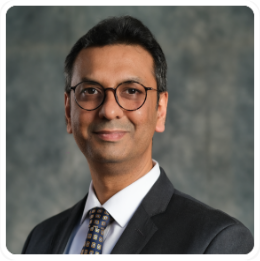
Nimesh Chandan has over 24 years of experience in the Indian Capital Markets. He has spent 18 years in Fund Management- managing and advising domestic and international investors, retail as well as institutional. Prior to joining Bajaj Finserv Asset Management Ltd, he has worked with Canara Robeco Asset Management as Head of Investments, Equities (Domestic and Offshore). He has also worked with other asset management companies including Birla Sunlife Asset Management, SBI Asset Management, and ICICI Prudential Asset Management.
{
"url":"",
"url_invest":null,
"debt": "Debt/Cash 100%",
"equity": "Equity 0%",
"HCRGG": {
"nav": "10000",
"date": "31-10-2024",
"since": {
"bajajflexi": "7.19",
"bajajsmall": "7.33",
"bajajnifty": "7.24"
},
"6_month_ago": {
"bajajflexi": "7.31",
"bajajsmall": "7.43",
"bajajnifty": "7.54"
}
},
"HCDGG": {
"nav": "10001",
"date": "31-10-2024",
"since": {
"bajajflexi": "7.38",
"bajajsmall": "7.33",
"bajajnifty": "7.24"
},
"6_month_ago": {
"bajajflexi": "7.50",
"bajajsmall": "7.43",
"bajajnifty": "7.54"
}
}
}
Category of Scheme
Multi Cap Fund
Benchmark
Nifty 500 Multicap 50:25:25 (TRI)
Min. SIP Amount
₹500
Inception Date
27-02-2025
Benefits of investing in Bajaj Finserv Multi Cap Fund
Invests in undervalued companies
Targets undervalued stocks for growth as the market corrects.
Capitalizes on market sentiment
Leverages market biases to spot overlooked opportunities.
Diversified across market caps
Invests in large, mid, and small caps for comprehensive growth.
Investment Objective
The objective of the scheme is to generate long term capital appreciation by investing in equity and equity related securities of large cap, mid cap and small cap companies.
However, there is no assurance that the investment objective of the scheme will be achieved.
About the Bajaj Finserv Multi Cap Fund
The Bajaj Finserv Multi Cap Fund invests across large, mid and small cap stocks, offering broad market exposure through a single portfolio. It follows a contrarian investing strategy, focusing on opportunities that may go against prevailing market trends. Instead of chasing popular stocks or reacting to short-term movements, the fund seeks out fundamentally strong companies that may be undervalued because of temporary challenges or negative sentiment.
This approach is based on the belief that markets tend to overreact to news, creating mispriced opportunities. By identifying such stocks early, the fund aims to benefit if their intrinsic value is eventually recognised.
Key aspects of contrarian investing:
- Goes against market trends by investing in stocks that may be currently out of favour.
- Focuses on undervalued companies with the potential for long-term growth.
- Requires patience, as value may take time to emerge.
- Aims to benefit if the stocks reach their fair value over time
- Helps minimise emotional, herd-driven decisions.
Asset Allocation
| Instruments | Indicative allocations (% of total assets) | |
|---|---|---|
| Minimum | Maximum | |
| Equity and Equity Related securities of following: | 75% | 100% |
| Large Cap Companies | 25% | 50% |
| Mid Cap Companies | 25% | 50% |
| Small Cap Companies | 25% | 50% |
| Debt and Money Market Instruments* and units of mutual fund schemes | 0% | 25% |
| Units issued by REITs and InvITs | 0% | 10% |
*Debt instruments shall be deemed to include securitized debts (excluding foreign securitized debt). Money market instruments will include commercial papers, commercial bills, Triparty REPO, Reverse Repo and equivalent and any other like instruments as specified by SEBI and Reserve Bank of India from time to time.
Who should invest in Bajaj Finserv Multi Cap Fund?
- Investors aiming to invest in undervalued opportunities, capitalizing on earnings growth and valuation multiple re-rating
- Investors looking for sound investment opportunities in times of volatility
- Investors with a horizon of 5+ years to realise the full potential of contrarian opportunities
- Investors looking for one stop solution with disciplined exposure to large cap, mid cap and small cap segments
Fund Managers
Fund Details
Type of Scheme
An open ended equity scheme investing across large cap, mid cap, small cap stocks.
Minimum Application Amount
- Lumpsum: Rs. 500/- and in multiples of Re. 1/- thereafter.
- SIP: Rs. 500/- and and above (minimum 6 instalments)
Load Structure/Lock-In Period
| Type of Load | Load chargeable (as %age of NAV) | |||||||||
|---|---|---|---|---|---|---|---|---|---|---|
| Entry | Nil | |||||||||
| Exit** |
|
|||||||||
**The load on other types of transaction could be Income Distribution cum Capital Withdrawal reinvestment, Switch in/out, SIP/SWP/STP (as applicable)
Product Label and Riskometer
Bajaj Finserv Multi Cap Fund
An open ended equity scheme investing across large cap, mid cap, small cap stocks
This product is suitable for investors who are seeking*:
- Wealth creation over long term
- To invest predominantly in equity and equity related instruments of large cap, mid cap, small cap companies.
*Investors should consult their financial advisers if in doubt about whether the product is suitable for them
Multi Cap Fund Overview
Multi-cap funds offer a diversified approach by investing in stocks across various market capitalizations, including large cap, mid cap, and small cap stocks. This flexibility allows fund managers to tap into opportunities in different segments of the market. By diversifying across market capitalisations, multi cap funds aim to combine the growth potential of smaller companies with the relative stability of large caps.
Mutual funds follow specific requirements based on the fund category. For instance, large cap funds need to invest predominantly in the top 100 companies by market capitalization, while small cap funds focus on smaller companies.
Multi cap funds, on the other hand, can invest across large cap, mid cap, and small cap stocks, maintaining a minimum 25% allocation to each. This gives them exposure to varying opportunities in each category in different market conditions.
Bajaj Finserv Multi Cap Fund - Regular & Direct Plans
When you invest in the Bajaj Finserv Multi Cap Fund, you can choose between two types of plans: Direct Plan and Regular Plan. Both follow the same investment strategy, but the way you invest and the expense ratio you pay differs.
Direct Plan
With this route, investors transact directly with the asset management company, without involving a distributor. Since there are no commission costs, the expense ratio is lower. It can be suitable for informed investors who want to independently create and manage their portfolio.
Regular Plan
Here, you invest through a distributor, who assists you with the fund selection and investment process. For this, the fund charges a commission fee in its expense ratio. This means the expense ratio is a bit higher than in the direct plan. However, it also means you get tailored fund recommendations based on your goals and risk appetite. The distributor also helps you with the investments redemptions and other processes.
The bottom line
Both plans invest in the same portfolio of stocks. The difference is in how you invest – a do-it-yourself approach or with guidance – and the cost you incur.
How to invest in Bajaj Finserv Multi Cap Fund
You can invest in Bajaj Finserv Multi Cap Fund either online or offline.
Offline mode: You can fill out the application form and submit it at any of the AMC's official points of acceptance (OPATs). If you are taking the help of a distributor, they may help you fill the form and submit it on your behalf.
Online Mode: You can invest through your Demat account. You can also go to Bajaj Finserv AMC’s investor portal. Create an online account, select the Bajaj Finserv Multi Cap Fund, and initiate an SIP or lumpsum. Invest now.
Taxation on Bajaj Finserv Multi Cap Fund
Bajaj Finserv Multi Cap Fund is an equity mutual fund, so it follows the tax rules applicable to equity-oriented schemes. The tax you pay depends on how long you stay invested.
Short-term capital gains (STCG): If you redeem your units within 12 months of purchase, any gains are classified as short-term and taxed at 20%, along with applicable surcharge and cess.
Long-term capital gains (LTCG): If you stay invested for more than a year, your gains are considered long-term. Gains up to ₹1.25 lakh in a financial year are exempt from tax. Any gains above that are taxed at 12.5%, plus surcharge and cess as applicable.
Explore Related Equity Funds
| ELSS Tax Saver Fund | Healthcare Fund | Flexi Cap Fund |
|---|---|---|
| Large and Mid Cap Fund | Small Cap Fund | Large Cap Fund |
| Consumption Fund | Banking and Financial Services Fund |
Other Mutual Fund Types
| Equity Funds | Debt Funds | Hybrid Funds | Index Funds |
|---|---|---|---|
| Exchange Traded Fund Funds | Savings Plus | All Mutual Funds |
Frequently Asked Questions
Multi Cap Funds invest a minimum of 25% each in large, mid and small cap companies. Flexi Cap Funds have no such limits and can invest across the market capitalization spectrum with a minimum investment of 65% in equity and equity related instruments.
Contrarian investing goes against market trends to find undervalued opportunities, leveraging inefficiencies for long-term gains.
Contrarian investing and value investing share similarities, as both involve buying attractively valued assets, but they differ in approach—contrarian investors go against market sentiment, while value investors focus on undervalued opportunities regardless of market trends.
-
Investors aiming to invest in undervalued opportunities, capitalizing on earnings growth and valuation multiple re-rating
-
Investors looking for sound investment opportunities in times of volatility
-
Investors with a horizon of 5+ years to realise the full potential of contrarian opportunities
-
Investors looking for one stop solution with disciplined exposure to large cap, mid cap and small cap segments
The Bajaj Finserv Multi Cap Fund is an open-ended equity scheme that invests across large, mid, and small cap stocks. The objective of the scheme is to generate long term capital appreciation by investing in equity and equity related securities of large cap, mid cap and small cap companies. However, there is no assurance that the investment objective of the scheme will be achieved.
You can invest in Bajaj Finserv Multi Cap Fund either online or offline.
- Offline mode: You can fill out the application form and submit it at any of its official points of acceptance (OPATs). If you are taking the help of a distributor, they may help you fill the form and submit it on your behalf.
- Online Mode: You can invest through your Demat and online trading account. You can also go to Bajaj Finserv AMC’s investor portal and create an account online to invest. Click here to invest now.
The NAV of a scheme changes on every business day. For the latest NAV, please refer to the scheme details above.
AUM (Assets Under Management) varies with market activity. Refer to the latest factsheet or scheme page for current figures.
The fund’s risk classification is based on the portfolio composition as well as SEBI guidelines and is subject to periodic review. Refer to the Riskometer above on this page or latest documents for the current risk level.
Top holdings may change over time. Please refer to the latest factsheet or scheme document for up-to-date information.
Being a multi cap fund, the scheme must invest a minimum of 25% of its portfolio each in large, mid, and small cap companies. The detailed asset allocation of the fund is mentioned in the Scheme Information Document.
No, there is no lock-in. However, exit load may apply if you redeem units early. Check the scheme document for details.
Expense ratios vary by plan (Direct or Regular). Please refer to the latest factsheet for current TER.
The ideal investment horizon can vary depending on your financial goals and market conditions. Multi cap funds are generally considered suitable for long-term investors, but it's best to consult a financial advisor to determine what works for your specific needs.
They invest across the market in large, mid, and small cap stocks offering a mix of relative stability and growth potential.
They carry very high market risk due to exposure in mid and small caps. However, the diversified structure can help mitigate risk to some extent.
Returns can vary based on several factors like market trends, fund strategy, and how long you stay invested.
If you're seeking diversification across market caps and have a long-term horizon, it may be suitable. Consider your goals and risk tolerance before investing.
Both have unique advantages and drawbacks. Multi cap funds require a minimum 25% allocation to each market cap, providing disciplined exposure, while flexi cap funds can flexibly adjust their portfolios across market caps. Your choice depends upon the investment strategy you find more suitable.
- Lumpsum: ₹500 and in multiples of Re. 1 thereafter
- SIP: ₹500 and above, with a minimum of 6 instalments
It focuses on fundamentally strong but undervalued companies, taking positions that go against short-term market sentiment.
The fund invests across large cap, mid cap, and small cap stocks, with a minimum exposure of 25% to each, ensuring disciplined exposure to all three market caps.
The portfolio is periodically reviewed and rebalanced to align with the fund’s strategy and market conditions. For latest details, please check the most recent Factsheet or the AMC website.
Yes, investors can switch between Direct and Regular plans subject to applicable terms and procedures.
Exit loads may apply if units are redeemed within a specified period; refer to the scheme documents for details. For latest details, please check the most recent Factsheet or the AMC website.
The fund holds a mix of large, mid, and small-cap stocks; allocations are updated regularly. For latest details, please check the most recent Factsheet or the AMC website.
The fund has a contrarian approach, seeking undervalued and overlooked opportunities. It seeks to maintain favourable risk-adjusted return potential with disciplined exposure to all market caps.
Learn About Mutual Funds
Posted On: 04 July 2023
When it comes to investing in the stock market, diversification is a key strategy to…
Posted On: 21 Aug 2025
Multi cap and mid cap funds each offer a distinct approach to equity exposure. In…
Posted On: 21 Aug 2025
Many investors with limited experience and modest funds may not have the bandwidth to invest…
Related Video
Be Future-Ready With Megatrends | Bajaj Finserv Flexi Cap Fund
Posted On: 30 Aug 2023
Benefit From Megatrends With Bajaj Finserv Flexi Cap Fund
Posted On: 30 Aug 2023
Long-Term Megatrends Investing with Bajaj Finserv Flexi Cap Fund
Posted On: 30 Aug 2023