Bajaj Finserv Banking and Financial Services Fund
Equity Fund Regular GrowthNAV
---
as of
Min. Investment Amount
Inception Date
01/12/2025
Risk Type Very High

An equity fund is a mutual fund that invests primarily in the shares of listed companies. It collects money from multiple investors and allocates it across a portfolio of stocks with the objective of generating long-term capital growth. These funds are managed by professional fund managers and offer diversification by investing across different companies and sectors, which may help reduce the impact of individual stock movements. Equity funds are generally suitable to investors who are comfortable with market-linked volatility and are seeking potential capital appreciation over the long term. Equity mutual funds come in various forms, some focusing on a specific market capitalisation (such as large cap, mid cap or small cap funds), others investing in companies of all sizes (such as multi cap funds) and some focusing on specific sectors or themes.
Equity funds function through structured portfolio management, regulatory oversight, and market linked valuation, as outlined below:
The following categories of investors may consider evaluating equity mutual funds:
SEBI categorizes equity mutual funds In India into several segments:
Key features include:
Benefits include:
Understanding the tax implications of equity funds can help you plan and optimize your investments effectively. Here are the taxation details for different types of equity mutual funds:
To choose an equity mutual fund scheme that may be suitable for you, consider factors such as your financial goals, risk tolerance, and investment horizon. Since equity funds invest in shares of companies, they may offer the potential for long-term wealth creation but also carry higher market-related risks compared to debt-oriented funds. Reviewing aspects like the fund category, performance trends*, and expense ratio may help in making an informed decision. It is also advisable to review scheme-related documents and, if needed, consult a financial advisor to assess whether the scheme is suitable for your profile.
*Past performance may or may not be sustained in future.
Before investing in an equity fund, investors should conduct thorough research and consider the following factors:
| ELSS Tax Saver Fund | Healthcare Mutual Fund | Multi Cap Fund |
|---|---|---|
| Large and Mid Cap Fund | Small Cap Fund | Large Cap Fund |
| Consumption Fund | Flexi Cap Fund | Banking and Financial Services Fund |
| All Mutual Funds | Debt Funds | Hybrid Funds |
|---|---|---|
| Exchange Traded Fund Funds | Savings Plus | Index Funds |

Investing isn’t just about numbers,…


In today’s fast-paced consumerist…

When markets fluctuate significantly…

Gold has traditionally been used in…

Image for representation purposes…

Gold often draws attention when…

Of the almost 4 crore unique…

Traditional wisdom in the mutual…

Retail investors predominantly…

A common question among investors is…
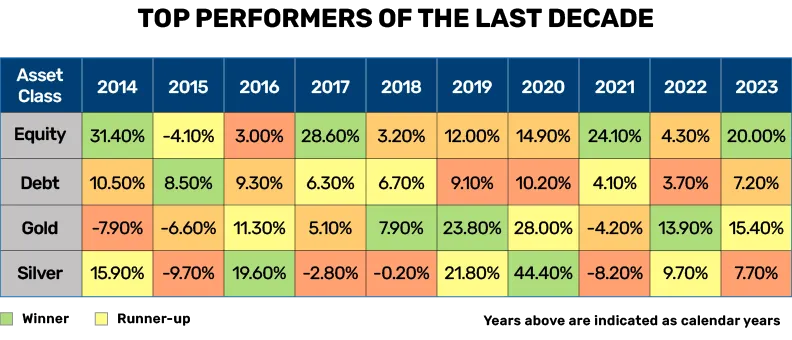
Equity, debt, gold, and silver have…

Recently, at a bustling farmers’…

Walk into your closet and take a…

You may not realise it, but when you…

Over the years, mutual funds have…

Planning for retirement involves…

Securing a comfortable post-…
Equity mutual funds primarily invest in stocks or equities. These funds aim to achieve capital appreciation by investing in companies with growth potential or undervalued stocks.
Yes, equity funds carry a higher level of risk compared to debt funds due to the volatility of the stock market. They are subject to market fluctuations, economic conditions, and company-specific risks.
When selecting an equity fund, consider your investment goals, risk tolerance, and time horizon. Look for funds with a consistent track record of performance, experienced fund managers, and a well-diversified portfolio aligned with your investment objectives. Conduct thorough research and seek professional advice if needed.
You can invest in equity mutual funds in India through SIP as well as lumpsum. SIP options can start as low as Rs. 500.
Equity mutual funds typically have a recommended investment horizon of at least 5 years or more. This longer timeframe helps to ride out market fluctuations and capture potential growth in stock prices.
Investing in equity funds in India can be beneficial for those seeking higher returns compared to traditional savings options like bank deposits. However, it involves market risks, so it's important for investors to have a long-term investment horizon and be prepared for fluctuations in value.
Equity refers to ownership in a company, typically through stocks, allowing direct exposure to stock market risks and returns. Mutual funds pool money from investors to invest in a diversified portfolio of stocks, bonds, or other assets, offering managed, lower-risk exposure than individual equity investments.
Equity mutual fund returns are subject to market risk and can fluctuate significantly from time to time. You can look at the past returns over three years, five years and longer intervals to get an idea of how much a scheme can potentially offer over multiple different market cycles. However, past performance may or may not be sustained in the future.
Equity funds tend to be volatile, especially in the short-term, and thus they may not be suitable for conservative investors and those with a low risk appetite. Such investors may consider debt mutual funds that offer relative stability and the potential for reasonable returns.
Neither is inherently better. Mutual funds offer diversification and professional management, which can mitigate risk and make investing accessible to beginners and those who do not have the expertise or time to track the markets. Direct equity carries higher risk but more control. It may be suitable for those who are familiar with the ins and outs of trading/investing and can control and manage their portfolios independently.
Yes, open-ended equity funds are generally liquid and you can redeem units when needed, but the value at redemption will depend on the prevailing Net Asset Value, which in turn depends on market conditions. Moreover, equity mutual funds are suitable for long-term investing, so it is advisable not to withdraw on impulse, as this may take you away from your goals. Lastly, capital gains on equity funds are taxable, so it is important to familiarise yourself with tax laws.
Cut-off time in mutual funds is the SEBI-specified time by which your purchase or redemption request must reach the fund house (subject to realization and availability of the funds in the bank account of mutual fund) to determine which day’s NAV will apply.
You may use online SIP calculators to estimate potential returns on your investment based on your investment amount, tenure and expected returns. However, the calculator’s estimates are for illustrative purposes only and actual returns will depend on market conditions – they are not fixed or guaranteed.
There is no fixed or universally suitable time to invest in an equity fund; the decision depends on your financial goals and investment horizon. Generally, the earlier you start, the more time your money gets to potentially grow through the power of compounding.
There is no single equity fund that may be considered ‘best’ for all investors. Suitability depends on individual factors such as financial goals, risk appetite, time horizon and market conditions.
Bajaj Finserv AMC’s equity fund offering continues to expand and currently includes funds such as the Bajaj Finserv Flexi Cap Fund, Bajaj Finserv Small Cap Fund, Bajaj Finserv Multi Cap Fund, Bajaj Finserv ELSS Fund, and Bajaj Finserv Banking and Financial Services Fund. You can find the latest and complete list of equity funds at the top of this page.
Equity funds include categories such as Large Cap Funds, Mid Cap Funds, Small Cap Funds, Flexi Cap Funds, ELSS Tax Saver Funds and sector or thematic funds.
Equity represents ownership in a company. For example, owning shares of a listed company gives the shareholder a proportional ownership interest in that business.
Equity funds may have an exit load, which is a charge applied if units are redeemed within a specified period. The amount varies by scheme and may be updated with time. You may the Scheme Information Document for details.
Investors may invest in equity funds through a Systematic Investment Plan (SIP) or a lumpsum amount, either online or offline, directly with the fund house or through a registered distributor.
Money may be withdrawn by placing a redemption request through the fund house’s website or an investment platform. The redemption amount is credited to the registered bank account, subject to applicable exit loads and processing timelines.

Megatrends investing means looking…
Megatrends help anticipate the…
Megatrends investing focuses on long…
 Go to the top
  Lumpsum Calculator Compound Interest Calculator SWP Calculator Step Up SIP Calculator Retirement Planning Calculator Wealth SIP Calculator Wealth Calculator STP Calculator Child Education Calculator Car Calculator Dream Home Calculator ELSS Calculator XIRR Calculator CAGR Calculator Simple Interest Calculator Mutual Fund Returns Calculator Index Fund Calculator Income Tax Calculator Investment Calculator Bajaj Finserv AMC office in Pune, Lohegaon Bajaj Finserv AMC office in Patna Bajaj Finserv AMC office in Ahmedabad Bajaj Finserv AMC office in Jaipur Bajaj Finserv AMC office in Chennai Bajaj Finserv AMC office in Mumbai, Bandra East Bajaj Finserv AMC office in Bengaluru Bajaj Finserv AMC office in Kolkata Bajaj Finserv AMC office in Chandigarh Bajaj Finserv AMC office in New Delhi Bajaj Finserv AMC office in Mumbai, Nariman Point Bajaj Finserv AMC office in Lucknow







 Home
Home Contact Us
 Login
Login Downloads
 Schemes